

rotatec is a Swiss manufacturer of rotary dental instruments. Since 1980 we have developed, manufactured and distributed diamond, carbide and polishing instruments in Appenzell, certified to ISO 13485 and compliant with the EU Medical Device Regulation (CE-MDR).
rotatec GmbH is a leading company in the manufacture and distribution of rotary dental precision instruments, headquartered in Switzerland in the heart of Appenzell.
As an ISO 13485 certified company, quality is our top priority. All our products are CE-certified and comply with the latest international standards. Since 1980 we have been manufacturing high-performance rotary instruments specifically for dentistry and dental technology. In response to growing customer needs, the production lines for carbide, diamond and polishing systems have been systematically expanded in recent years. Our production focuses on the processing of sintered carbide, steel, natural diamond and natural rubber elements together with the corresponding synthetic resin bonds.
Continuous reinvestment in our products and manufacturing processes, combined with the personal commitment of our employees, has earned us a strong position in the market. Our core markets are the German-speaking DACH region, Switzerland and Germany. The Swiss location is key to the high-quality selection of skilled specialists and raw materials in production. rotatec GmbH is your manufacturer of rotary dental instruments for practices and laboratories!
rotatec at a glance
| Founded: 1980 | Headquarters: Appenzell, Switzerland |
| Activity: Development, manufacturing and distribution | Product lines: Diamond, carbide, polishers |
| Brands: rotatec, D.E.M. | Quality: ISO 13485, CE-MDR, Swiss made |
| Core markets: Switzerland, Germany, DACH region | Users: Dental practices, clinics, dental labs |
| Website: https://rotatec-swiss.com | Made in Swiss |
Catalogue
Diamond instruments
Perfect control in every area of application
Rotatec Diamond Instruments for Dental Practices and Laboratories
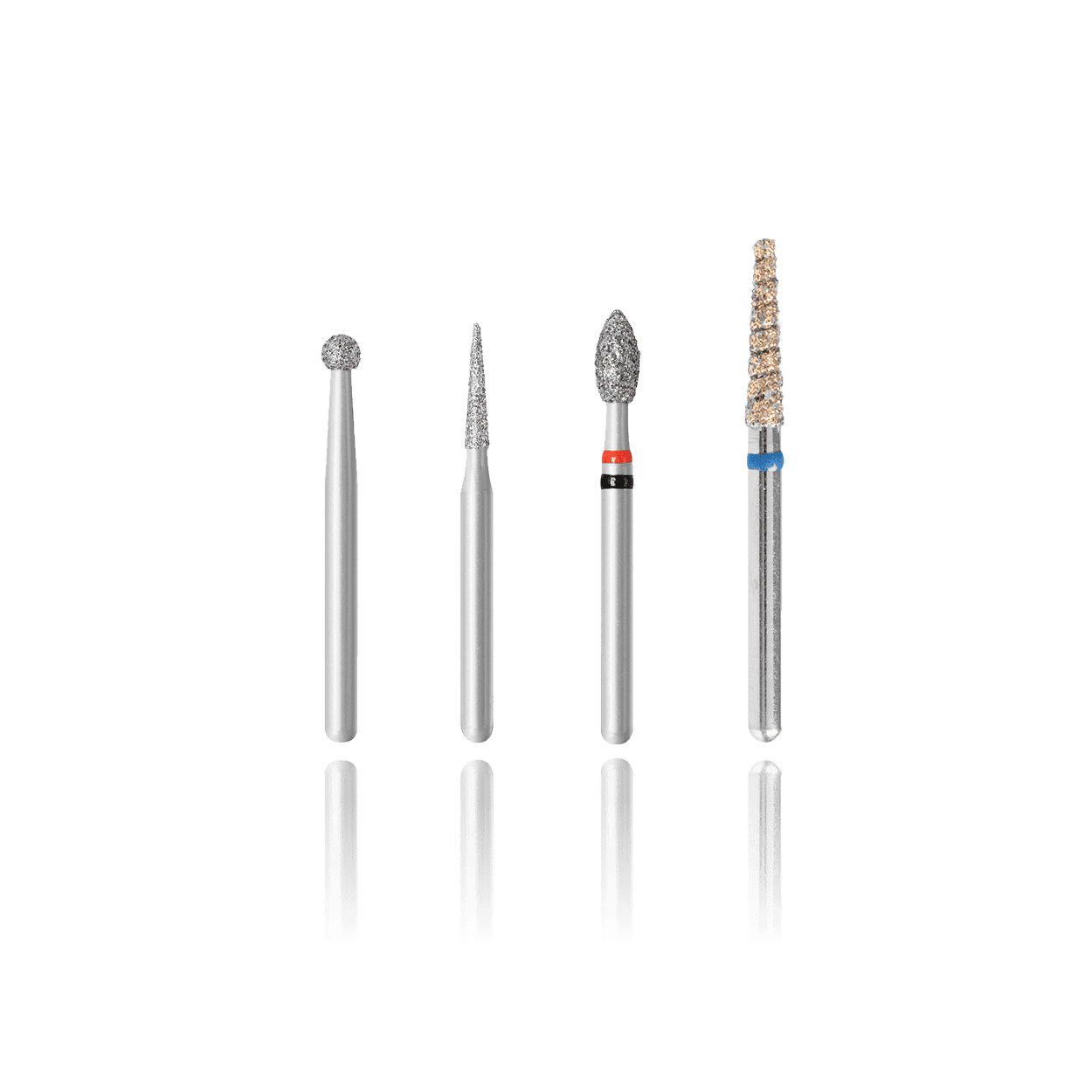
Diamond burs by rotatec are rotary instruments for cavity, crown and chamfer preparation as well as for finishing and contouring restorations. They work enamel, dentine, ceramics, zirconia and composite in clinic and laboratory.
The galvanically bonded natural diamond grits on a stainless steel body provide even removal, consistent grinding performance and low heat generation with smooth, low-vibration running. The range runs from ultra coarse for rapid removal to ultra fine for the finest contouring.
To meet diverse clinical needs, Rotatec instruments are available in up to seven different grit sizes, allowing dental professionals and laboratories to achieve the highest precision and working results.
Which diamond bur do I need for which preparation?
Grit decides, not shape: coarse grits remove structure, fine grits work the preparation margin. The standardized color ring on the shank shows the grit without you having to inspect the instrument.
| Color ring | Grit | Working step |
|---|---|---|
| Blue | Ultra coarse | Crown reduction, rapid removal |
| Black | Extra coarse | Coarse shaping |
| Green | Coarse | Cavity and crown preparation |
| No ring | Standard | Routine preparation, general reduction |
| Red | Fine | Finishing the preparation margin |
| Yellow | Extra fine | Contouring before polishing |
| White | Ultra fine | Finest contouring, smoothing composite |
Why do most clinicians reach for the coarse grit?
Because it works fast. Surveys show that more than two thirds of users reach for diamond instruments with a green colour ring, meaning coarse grit.
For removal that is correct. It becomes a problem when the same grit also works the preparation margin: coarse grits leave scratches that compromise the impression and the marginal fit. Skipping more than one grit step costs more polishing time later than the saved instrument change is worth.
FG, RA or HP: which shank fits which drive?
FG belongs in the turbine, RA in the contra-angle handpiece, HP in the straight handpiece. The shank therefore determines the speed and the control you have over the instrument.
FG instruments work at high speed with light contact pressure, typical for preparation. The RA shank in the contra-angle handpiece allows controlled work at lower speed, for example when excavating or finishing. HP instruments with a larger working part are used in the laboratory and in surgery.
What does the ISO number tell you about an instrument?
The ISO number describes an instrument completely: material, shank, length, shape and grit. It consists of five groups of digits under ISO 6360 and is independent of the manufacturer.
The first group names the material of the working part: 806 stands for galvanically bonded diamond, 500 for tungsten carbide. The second group identifies shank and length, for example 314 for the FG shank. Shape and grain size follow. In practice this means two instruments with an identical ISO number are interchangeable, no matter where you order them.
When is a diamond instrument worn out?
When it requires more contact pressure than usual. A visibly thinned coating, glazed areas, or an instrument that smears instead of cutting should be replaced.
Diamond instruments can be reused several times when reprocessed by a validated procedure. What matters is immediate cleaning after the procedure, before residues dry on and clog the spaces between the grains. More pressure does not compensate for a worn coating: it generates heat, endangers the pulp and shortens the remaining service life further.
When is it worth switching to rhodia or turbodia?
For zirconia and for long preparations. For hard materials rhodia works with a higher diamond concentration, and for high removal with good chip flow turbodia uses a spiral coating.
After preparation, finishing burs take over the fine contour, and polishers then lead to a high gloss in increasing fineness.
Carbide instruments
Maximum efficiency for flawless work results
Carbide burs made of tungsten carbide cut by chip removal rather than grinding. They suit preparation, the removal of old amalgam and composite fillings, and working composite, metal and acrylic in clinic and laboratory.
The defined blade geometry ensures low-vibration, precise work and leaves smooth cut surfaces. Available with FG, RA/WST and HP shanks.
Direct from the Swiss manufacturer in Appenzell. Swiss made to ISO 13485, CE-MDR, stock items ready to ship.
When should I use carbide instead of diamond?
Carbide cuts, diamond grinds. Wherever a smooth cut surface and tactile control matter, carbide is the first choice.
| Task | Material | Why |
|---|---|---|
| Sectioning amalgam | Carbide | Cuts the metal instead of smearing it |
| Removing composite | Carbide | Clean cut without smearing |
| Reducing enamel | Diamond | Enamel is too hard for a blade |
| Working ceramics | Diamond | Brittle material, abrasive removal |
| Bone | Carbide | Chip transport, low heat |
| Acrylic in the laboratory | Carbide, coarse fluting | Large chip space, clogs less |
How do I remove amalgam fillings safely?
Section it out in large pieces rather than grinding it away. This generates less heat, less fine dust and less vapour than drilling out the whole surface.
The standard protocol includes rubber dam for isolation, high-volume suction directly at the tooth, and continuous water cooling, which limits temperature and therefore mercury vapour. The instrument cuts channels along which the amalgam can be removed in segments. A coarsely fluted carbide bur works faster than a diamond for this and does not smear the metal.
Which fluting do I need for what?
Coarse cross-cut fluting removes material quickly, fine fluting leaves smooth surfaces. The blade count determines the balance between speed and surface quality.
For opening and removal, a coarse fluting with a large chip space is sufficient. For contouring composite margins, reach for finishing burs with a high blade count, which remove less but work considerably more smoothly.
Why does cutting performance decline?
Usually because of excessive contact pressure or incorrect speed, less often because of genuine wear. Dried-on residues also make an intact instrument appear blunt.
Check the cleaning first: acrylic and cement residues in the chip spaces prevent cutting. If performance is still absent after reprocessing, the blades are rounded and the instrument should be replaced. More pressure does not compensate, it only generates heat.
Which shank for which drive?
FG for the turbine, RA and WST for the contra-angle handpiece, HP for the straight handpiece in the laboratory and in surgery.
This page can be filtered by shank type. For caries excavation we offer round burs and excavators, and for surgical procedures surgical instruments.
Polishers

Polishers by rotatec bring composite, ceramics and metal to a high gloss. The abrasive-impregnated instruments work without additional polishing paste and can be used in clinic and laboratory.
Multi-step polishing systems lead, in the intended sequence, to a smooth, plaque-resistant surface. Various shapes and hardness grades cover every indication, and the colour coding shows the polishing step.
Direct from the Swiss manufacturer in Appenzell. Swiss made to ISO 13485, CE-MDR, stock items ready to ship.
in which order do I polish a restoration?
Each step removes the scratches of the previous one. If a step is skipped, the coarser structure remains visible and the high gloss never appears.
| Step | Purpose | Recognizable by |
|---|---|---|
| Finishing | Working out contour and margin | Shape is right, surface still matt |
| Pre-polishing | Leveling the scratches from finishing | Evenly matt surface |
| High-gloss polishing | Smoothing the surface | Silky matt sheen |
| Fine polishing | Creating the final gloss | Mirror-like surface |
At what speed and pressure should I polish?
With light pressure and low speed. For composite polishing, 8,000 revolutions per minute should not be exceeded.
Higher speed generates heat, and heat smears the composite surface instead of smoothing it. This shows as a milky haze that further steps can no longer remove. Polish in each step until no further improvement is visible, then change.
Can I use the same polisher for ceramics and composite?
No. Ceramics require different bonds and grits than composite because they are harder and more brittle.
A composite polisher wears down quickly on ceramics without smoothing them. Conversely, a ceramic polisher removes too much from composite and destroys the contour. This page can be filtered by the material to be worked on.
When is a polisher worn out?
When the surface glazes over or the gloss fails to appear. A polisher that only warms the surface is no longer working.
Many polishers can be reprocessed but lose effectiveness with each cycle, because the abrasive is washed out. Shape retention is a second criterion: a cup that has lost its contour no longer reaches the fissures.
How do finishing and polishing relate?
Polishing does not repair contour. Whatever the finishing bur has not achieved in shape and margin, no polisher will fix.
Polishing begins only once shape and margin are correct. For professional cleaning we offer prophylaxis instruments, and for fissures and hard-to-reach areas brushes.
